AI Content Optimisation Services in Leeds & Yorkshire

AI is changing how people search for information, but also how businesses need to create, structure and maintain website content.
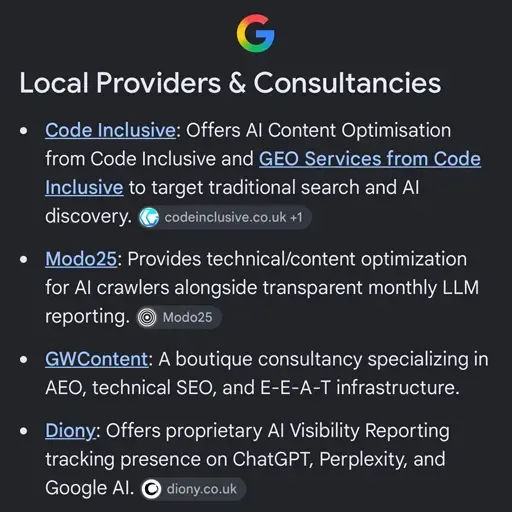
At Code Inclusive, we provide AI content optimisation services in Leeds and across Yorkshire, helping organisations improve existing website content so it is clearer, more authoritative, more useful and better structured for modern search environments.
Our approach combines traditional search engine optimisation with content engineering, semantic relevance, entity development, local optimisation and the requirements of increasingly AI-driven search experiences.
AI content optimisation is not simply about adding more keywords to a page. Nor does it mean using artificial intelligence to automatically rewrite everything on a website.
It involves examining how effectively a page communicates its subject, expertise, services, geographical relevance and supporting evidence to both people and machines.
For Yorkshire businesses, this creates an important opportunity.
A website may contain hundreds of pages yet still fail to communicate clearly why the organisation is relevant to a customer in Leeds, Harrogate, York, Bradford, Wakefield or elsewhere across the region.
Code Inclusive helps close that gap.
What Is AI Content Optimisation?
AI content optimisation is the process of improving digital content so its meaning, usefulness and relevance can be understood efficiently by human visitors, search engines and AI-powered discovery systems.
That requires considerably more than conventional keyword placement.
We examine elements such as:
- Search intent
- Subject coverage
- Semantic relevance
- Brand identity
- Brand messaging
- Entity relationships
- Factual clarity
- Information hierarchy
- Originality
- Local relevance
- Supporting evidence
- Internal linking
- Content duplication
- Answer completeness
- Page purpose
- Conversion intent
- Structured data opportunities
- Technical accessibility
The objective is to turn ordinary website copy into a stronger information resource.
For example, a Yorkshire engineering company may have a page stating that it provides specialist engineering services.
That statement provides very little useful context.
What engineering disciplines does it support? Which industries? What equipment, processes or standards are involved? Where does it operate? What type of projects can it undertake? Who are its typical customers? What makes its experience different?
Effective optimisation develops those relationships naturally throughout the content.
The resulting page is more useful to the prospective customer while simultaneously providing search systems with significantly more context.
Content Optimisation is Different to AI Content Generation
One of the most important distinctions we make is between generating content with AI and optimising content for an AI-influenced search environment.
They are not the same thing.
Generative AI can produce substantial quantities of text extremely quickly. Volume, however, does not automatically create authority.
Publishing hundreds of generic articles can leave a website with:
- Repetitive information
- Weak subject differentiation
- Thin location pages
- Overlapping search intent
- Unnecessary URLs
- Generic advice
- Poor internal linking
- Little first-hand knowledge
- Limited commercial value
Our optimisation process takes the opposite approach.
We look for ways to increase the information value of individual pages.
Sometimes that requires additional content.
Sometimes it requires removing content.
Frequently, the greatest improvement comes from restructuring existing information, introducing genuine expertise, consolidating overlapping pages and making the purpose of each URL considerably clearer.
AI Content Audits
A Code Inclusive AI content optimisation project can begin with a detailed assessment of the existing website.
Rather than treating every URL equally, we analyse what role individual pages perform within the wider website.
This can include reviewing:
- Core service pages
- Product and category pages
- Location landing pages
- Blog articles
- Case studies
- FAQs
- About and company information
- Technical resources
- Knowledge centres
- Sector pages
We look for pages that are performing, pages with unrealised potential and pages that may be weakening the overall quality of the website.
This allows businesses to prioritise improvements rather than continually publishing additional material.
Moving Beyond Keyword Density
Traditional SEO was once heavily influenced by exact keyword usage.
Modern search interpretation is far more sophisticated.
A strong page about commercial property development in Leeds, for example, should naturally establish relationships between relevant concepts without repeatedly inserting the same target phrase.
Depending on the subject, those concepts might include planning, land acquisition, construction, investment, development finance, contractors, building regulations, regeneration and geographical areas.
We therefore optimise around subjects and relationships, not arbitrary keyword percentages.
Primary search phrases remain important, particularly within page titles, headings and prominent content, but they form part of a much broader semantic structure.
Creating Genuine Information Gain
One of our primary objectives is identifying what a business can contribute that competing websites cannot.
This is where valuable content becomes difficult to imitate.
Potential sources of original information include:
- Project experience
- Internal data
- Customer questions
- Proprietary processes
- Technical expertise
- Regional knowledge
- Pricing information
- Original photography
- Case studies
- Testing
- Comparisons
- Lessons learned
- Specialist opinions
Consider two pages about website development.
One repeats standard claims about responsive design, SEO and user experience.
The other explains the development methodology, provides real performance examples, discusses technology selection, identifies common project failures and demonstrates experience through completed work.
The second page possesses substantially greater information value.
Our role is to uncover and communicate that value.
Optimising Content for Questions and Answers
AI-assisted discovery is increasing the importance of detailed, conversational queries.
Potential customers do not only search:
SEO Leeds
They may ask:
- How much should a small business in Leeds spend on SEO?
- Why isn't my Yorkshire business appearing in Google?
- Should a local service company create separate pages for Leeds and Harrogate?
These searches reveal specific intentions.
We analyse the questions surrounding a subject and determine which deserve to be answered within the main page.
Answers should be direct where appropriate, but optimisation should not reduce an entire website to hundreds of artificial question-and-answer blocks.
The surrounding explanation, expertise and evidence remain essential.
Local AI Content Optimisation for Leeds
Leeds has a diverse commercial environment encompassing financial services, legal services, healthcare, digital technology, manufacturing, engineering, construction, retail, hospitality and a substantial SME sector.
A company competing within Leeds therefore needs more than simply adding "Leeds" to a national service page.
We examine whether content demonstrates a meaningful connection with the market.
Depending on the business, local optimisation can incorporate:
- Areas genuinely served
- Local projects
- Leeds customer examples
- Regional industry knowledge
- Relevant case studies
- Local terminology
- Service coverage
- Original photographs
- Business location information
- Regional testimonials
- Local FAQs
The purpose is to create evidence of relevance, rather than artificially repeating geographical keywords.
Reaching Customers Across Yorkshire
Code Inclusive's AI content optimisation services are available to businesses throughout Yorkshire.
Strategies can be developed for organisations serving locations including:
Leeds, Wetherby, Harrogate, York, Bradford, Wakefield, Huddersfield, Halifax, Ilkley, Otley, Guiseley, Yeadon, Pudsey, Farsley, Knaresborough, Ripon and surrounding areas.
However, creating a landing page for every town is not automatically the correct strategy.
Location expansion needs to be justified.
We assess:
- Whether there is genuine search demand
- Whether the business serves the location
- Whether sufficient unique information exists
- Whether the location deserves a dedicated page
- Whether an existing regional page would perform the role better
- Whether multiple pages are competing for similar searches
This creates a much more sustainable local content architecture.
Page Performance
Heavy scripts, oversized media and inefficient code can damage the user experience even when the written content itself is excellent.
XML Sitemaps
Important canonical URLs should be represented accurately within the website's XML sitemap architecture.
Structured Data and Content
Structured data can provide machines with additional context about information already presented on a website.
Depending on the page and organisation, appropriate schema may help identify:
- The organisation
- Local business information
- Services
- Products
- Articles
- People
- Breadcrumbs
- Events
- Videos
Structured data should accurately reflect visible page information.
We do not recommend adding schema simply because a particular markup exists. Implementation should have a clear purpose and accurately describe the underlying content.
Internal Linking as a Content Signal
Internal links do much more than help visitors move between pages.
They establish relationships between information.
A strong Yorkshire SEO page might logically connect with pages covering:
technical SEO → content optimisation → local SEO → SEO audits → AI search optimisation → relevant case studies.
This creates an interconnected subject architecture.
During optimisation, we review both links entering a page and links leaving it.
Important pages hidden deep within a website with few internal links can be difficult for users and crawlers to discover.
Content Designed to Convert as Well as Rank
Traffic without commercial purpose has limited value.
Our content optimisation therefore considers what a visitor should do after reaching the page.
Depending on the business, that could mean:
- Requesting a quotation
- Calling the company
- Booking a consultation
- Purchasing a product
- Downloading information
- Visiting another service page
- Completing an enquiry form
Calls to action should appear at logical stages rather than being inserted aggressively after every paragraph.
A visitor who understands the service, trusts the provider and sees a clear next step is considerably more valuable than an anonymous page view.
How Code Inclusive Approaches AI Content Optimisation
Every website requires a different strategy, but our methodology generally follows several stages.
- Discovery
We establish the organisation's services, customers, geographical coverage, commercial objectives and genuine areas of expertise. - Content Inventory
Existing pages are reviewed to understand the current information architecture. - Search and Intent Analysis
We determine what potential customers are actually trying to find and which pages should satisfy those requirements. - Gap Analysis
Missing subjects, weak explanations, unanswered questions and insufficient supporting evidence are identified. - Optimisation
Pages are rewritten, expanded, consolidated or restructured where necessary. - Technical Alignment
Indexability, metadata, canonicalisation, internal linking and relevant structured information can be reviewed alongside the content. - Local Enrichment
Where geographical targeting is commercially relevant, genuine Leeds and Yorkshire context is incorporated. - Measurement
Performance can subsequently be assessed through impressions, search positions, clicks, engagement, enquiries and conversions.
AI Content Optimisation from Code Inclusive
The future of online content is unlikely to be won by the company publishing the greatest number of words.
Quality, clarity, originality, technical accessibility and demonstrable expertise are becoming increasingly important.
Our AI content optimisation services in Leeds and Yorkshire help businesses examine what their websites are communicating and improve the information that matters.
Whether you have a small service website, an established eCommerce operation or thousands of legacy pages, we can identify where content can be strengthened, consolidated or repositioned.
The objective is straightforward:
- Create content worth finding
- Content that answers real questions
- Content that demonstrates genuine expertise
- Content with a clear purpose
- Content capable of supporting visibility across traditional search, AI-assisted discovery and whatever comes next.
Discuss Your AI Content Strategy
If your website contains valuable expertise but isn't generating the search visibility or enquiries you expect, Code Inclusive can assess where improvements can be made.
Contact Code Inclusive to discuss AI content optimisation in Leeds, Yorkshire or across the UK and develop a strategy based on your existing website, commercial objectives and target audience.
For more information use our contact form or email sales@codeinclusive.co.uk.
We look forward to hearing from you.